“The mind is its own place, and in itself can make a heav’n of hell, a hell of heav’n.” – John Milton
Jiaya holds that nearly every world tradition, faith, or religion has something important to teach us in regards to our interconnected nature. Humans have long intuited an underlying sense of oneness with the cosmos, which is evident in the themes shared in countless stories passed down through the ages.
The fall of man — Chapter 3 of the Book of Genesis — is one such influential story. For those steeped in Catholic and Protestant doctrine, the story may be an uncomfortable one associated with baggage like original sin or the misogynist assignment of all the world’s evils to the first woman. However, the narrative reads rather differently when approaching it from a Jiayan perspective.
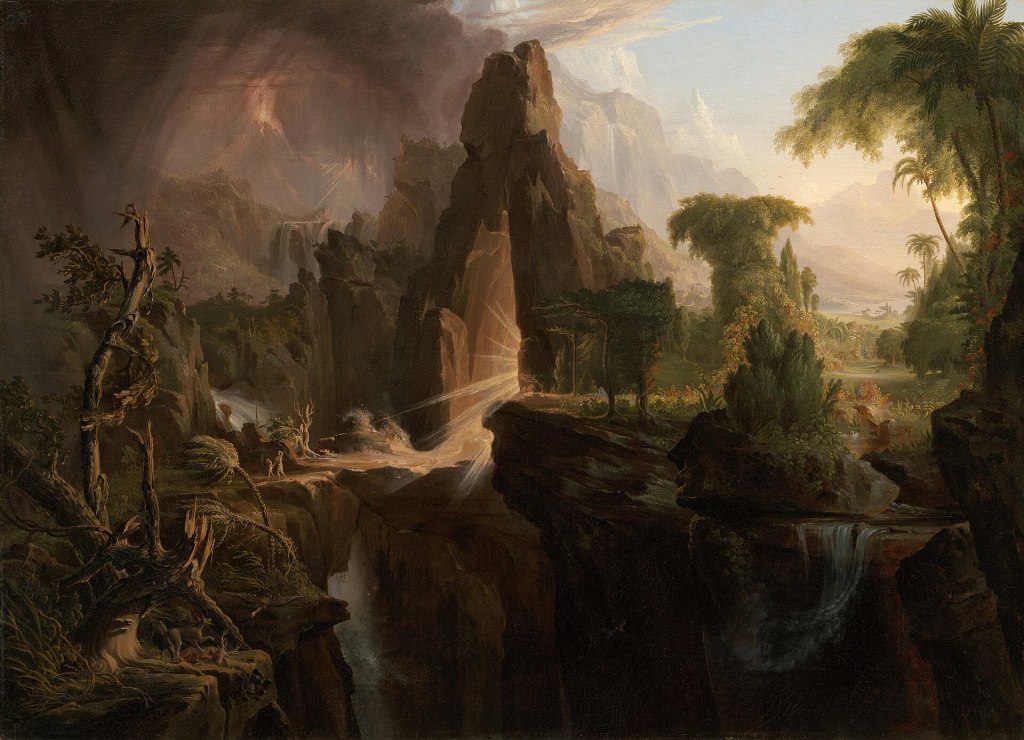
In the two previous chapters, it is established that Adam and Eve reside in the idyllic paradise of Eden where there is no decay, pain, or violence. We may think of this as a primeval period of human prehistory when the ancestors of modern humans were lacking in awareness of the world around them, similar to that of other sentient animals. This is not to say that they weren’t intelligent, but they were not modern humans as we would understand them. Rather, they coexisted peacefully within other beings within the interdependent web of Nature. There would be no “death” or violence, because there was no human culture to perceive such things.
At the beginning of Chapter 3, we’re introduced to the serpent. Across many traditions, the serpent has symbolized rebirth, cyclicity, and transformation. Perhaps most notably, the Mesoamerican serpent and creator deity Quetzalcōātl was associated with vegetational renewal and learning (think the Agricultural or Neolithic Revolution). This is how we should interpret the character of the serpent in Genesis 3 — not as a malevolent force (and least of all, as an antagonistic anti-God), but a transformative figure. The arrival of the serpent heralds the beginning of human behavioral modernity and thus, man’s arrogantly presumed separation from the rest of Nature.
The serpent successfully tempts both Eve into eating from the tree of the knowledge of good and evil by promising that she will be “like God.” My theory is that Eve is tempted with the fruit and must bring it to Adam because women were often the foragers in hunter-gatherer societies (though recent discoveries are challenging this notion). This section represents humans gaining a cosmic awareness.
If we view God as the principle of Ji rather than the anthropomorphic deity he is so often portrayed as, we can view Ji’s attempts to stop humans from attaining this awareness as a way to maintain cosmic balance. Once humans transitioned into behavioral modernity, they believed themselves apart from and above the wider web of existence. The growth of states led to the formation of unjust hierarchies, rampant violence, and environmental destruction which blinded humans to their link with Ji. To be sure, this awareness is not without its blessings. The same cognitive shift that led to separation also made possible the emergence of language, symbolic thought, ethics, and compassion beyond kinship — the very tools through which humans could remember their unity with Ji.
It becomes clearer what the fall represents when we move further to verses 7 onward. Adam and Eve suddenly become aware of their nakedness, representing the early use of clothing and humanity’s loss of innocence. God informs Eve that the pain of childbirth will be “exceedingly great.” Indeed, due to the development of bipedalism, childbirth for humans is considered a more difficult and strenuous process compared to other animals. While the statement in verse 16 that Eve’s husband “shall rule over [her]” has long been interpreted as an endorsement of patriarchy, I view it as merely an acknowledgement of it. With the establishment of stratified societies and agricultural labor, the egalitarianism of hunter-gatherer societies fizzled out. God’s punishment to Adam is a clear metaphor for the onset of the Neolithic Revolution. God forbids Adam from eating fruit (obviously not a literal punishment; it should be clear by this point we’re not dealing with a historical account here), instead instructing him to toil the ground “all the days of [his] life.”
By the end of the story, humanity has “fallen,” not because of any “sin” in the theological sense of the word, but because its greater understanding of the universe has now placed it on a different playing field compared to other beings. The narrative in Genesis presents our capacity to understand our place in the world as a burden, rather than a gift. Many of the troubles and inequalities that existed at the time in which the story was written — which arose as a direct result of the Agricultural Revolution and color the tone of the story — still exist today. Genesis 3 reminds us that it is our sacred duty — and our unique possibility — to come back into Eden-like alignment with Ji, not by undoing our awareness, but by using it to illuminate the path home in the context of this so-called fallen world we have created.
 Jiaya
Jiaya 
Leave a comment