“Democracy must begin at home, and its home is the neighborly community.” – John Dewey
Recently, I’ve been pondering how the inside of a Jiayan meeting house or temple might look. In an ideal Jiayan society — one that affirms the equality, dignity, and interconnectedness of all things in its actions; not one that is ruled by an explicitly Jiayan government — such buildings would not simply serve as places of spiritual reflection but as vital “third places,” spaces outside of home and work that sustain community, democracy, and societal flourishing.
Across much of the modern world, the decline of such places has been accompanied by rising loneliness, polarization, and disconnection, particularly among the youth. A Jiayan temple must therefore be more than a hall of meditation. It would serve as a refuge for displaced and unhoused peoples, a place for those seeking spiritual renewal, and a vital location within communities for information and for gatherings.
The name itself is flexible: “temple” and “meeting house” can be used interchangeably depending on one’s preference. Jiaya is both spiritual and philosophical, not oriented toward worship in the conventional sense, but towards the realization of Oneness. For some, “temple” might imply ritual reverence, which is not misplaced here, for Jiaya calls us to honor the interconnectedness of all things (hence it’s the term I prefer). Yet “meeting house” captures equally well the communal and restorative function.
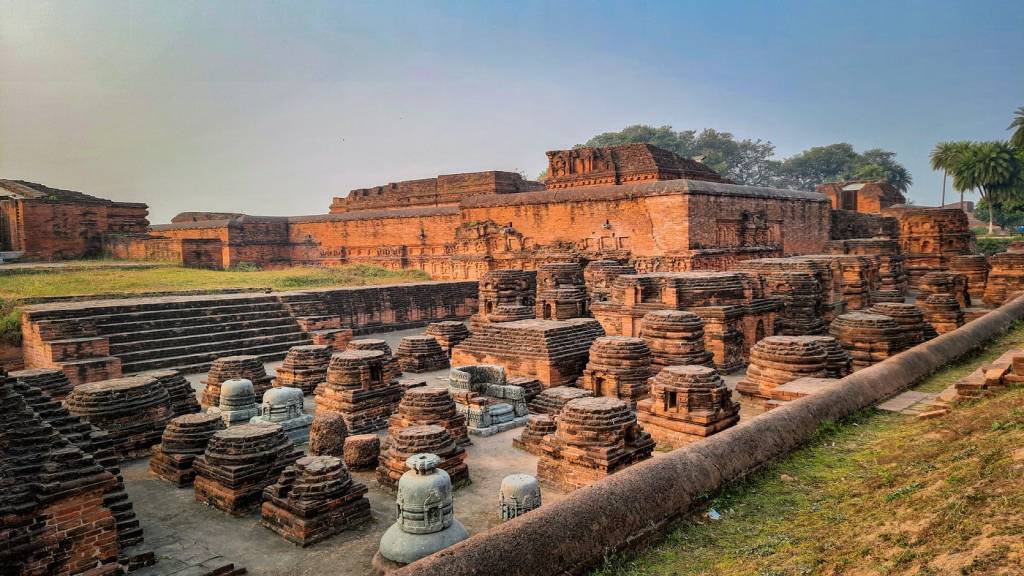
A Jiayan temple, as I imagine it, would serve many roles. First and perhaps foremost, it would be a library — a living archive that seeks to house the cultural, philosophical, religious, spiritual, and scientific wisdom humanity has accumulated over the millennia. In this way, it would carry forward the wisdom of such grand libraries as those at Alexandria, Nalanda, and Baghdad: places where learning was not hoarded but shared as the common inheritance of us all.
Secondly, the temples would serve as a place of gathering, whether that be for public forums, civic meetings, study circles, or simply to unwind with peers. That leads us to the temples’ tertiary purpose: to calm, delight, and soothe visitors into a state of equanimity through the natural beauty in which they are constructed. I imagine they would be set amongst gardens, water, trees, or other forms of nature suited to the land in which they stand.
No two Jiayan temples should look alike. Reflecting the Jiayan teaching of equality in diversity, each temple ought to reflect the culture and ecology of its homeland and the people by which they are built. What they must have in common is their welcoming atmosphere of belonging and serenity — that these are places where one can go to relax, learn, meet friends, find new companions, or reemerge with a greater understanding of one’s place in their community and the universe at large.
A Great Tapestry
“You are not a drop in the ocean. You are the entire ocean in a drop.” – Rumi
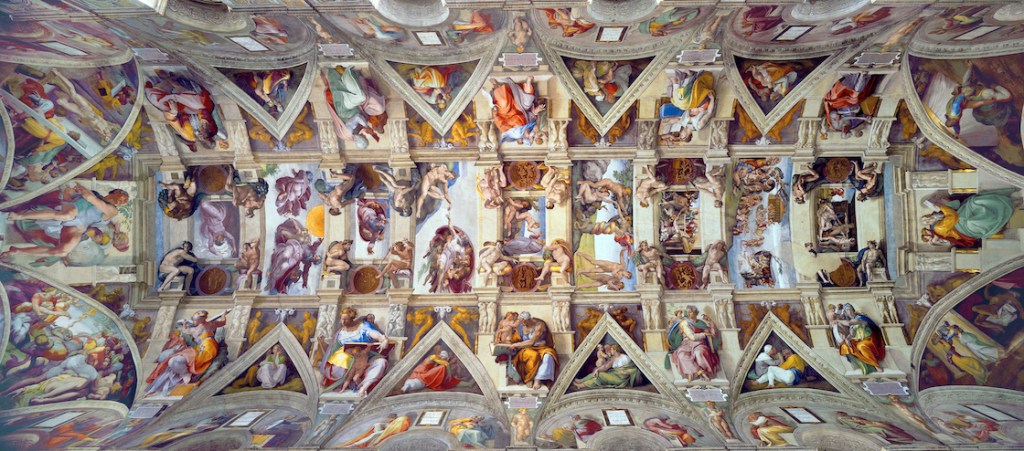
In the library area of such a temple (perhaps the largest of them all), I envision a vast tapestry displayed, fusing the elegant Neoclassical form with the Romantic spirit of symbolism and nature. The figures depicted would be rendered with perfect clarity, conversing and interacting in realistic ways. By contrast, the natural and cosmic landscapes would be portrayed in a more idealized fashion.
The tapestry unfolds in layers, arranged like a half-concentric mandala, radiating outward and upward like a sunrise. At its root lies the earthly layer’s grounding tree, representing the Bodhi Tree, Yggdrasil, Ya’axché, and the Tree of Life, all at once. Beneath its shade sits the Buddha in vitarka mudra, before him a lotus blooming in water. To his left, Jesus delivers the Sermon on the Mount, a white dove rising above him. To the Buddha’s right, Krishna counsels Arjuna.
Together, these three wise instructors stand as humanity’s enduring teachers within the work, exemplars of the moral center. Scattered among them are animals, plants, and a diverse array of human beings — both a selection of members of the Areteioi Canon and nameless people who walk the path of epektasis. For every figure remembered in history, two ordinary people stand beside them, symbolizing the truth that virtue is not the possession of the few but the calling of all. Just below this earthly layer is a horizontal swirling pillar of cleansing fire, representing what awaits those who shun the Cosmic Standard and wreak havoc upon the world through their evil and unskillful ways.
Above this earthly layer are the clouds, parting to reveal a heavenly assembly of intercessors: twenty deities drawn from across human cultures, and all nude, representing humanity’s innocence and connection with divinity before our perceived separation from Ji. Maitreya embodies hope for the future; Ma’at (in the center) weighs the world upon her scale. Shiva flows in the dance of yoga and the arts, his multiple blue arms outstretched. Amaterasu radiates the sun’s beams towards the earth below. Pachamama nourishes the earth. Apollo strums a lyre while Minerva writes strategy. Guanyin sits upon the clouds with serene warmth. Inanna embodies sexuality and procreation, while Freyr complements her with fertility, agriculture, and peace.
Anansi, crowned with a spider headdress, represents right speech and resilience against oppression. Quetzalcoatl holds the wisdom of numbers and the calendar, while Mithra inscribes law upon tablets. Oshun pours water from the clouds, and Brigid extends healing and protection. Lakshmi offers flourishing and prosperity, and Tangaroa cares for oceans and climate. The Spider Grandmother tends the golden web of Ji that underlies the tapestry (a little more on that later). Phra Mae Thorani wrings her hair, releasing torrents of detachment down to the earth. Finally, Xōchipilli bursts with flowers, music, and joy. Together, they form humanity’s bridge to the divine.
Above them lies the cosmic layer, in which the Rainbow Serpent arcs across a purplish-red expanse of stars, separating heaven from the infinite sky. The sun and moon appear with faces, joined by the planets of our solar system (arranged in no particular order) and galaxies glowing in mystic wonder.
Finally, the uppermost layer, bathed in light, shine the words of ultimate unity that represent the truth of Ji that has radiated across all cultures since the dawn of time. Logos, Manitou, YHWH, Allah, O Thou Glory of Glories, Qi, and Brahman. They stand as symbols of the unnameable, beyond every creed yet suffusing us all.
Throughout the whole tapestry, faint but nonetheless present, stretches the golden web of Ji — the interconnection of all things; there for anyone who tries enough to see it. It permeates the background of every layer, the foundation of earth, the bridge to heaven, and the fabric of the cosmos. It reminds the viewer that though our cultures, languages, and histories are many, they are woven together into one pattern.
Thus, the vision of the Jiayan temple is not that of an escape from the world but one that unites it. One where beauty, knowledge, community, and reverence converge, serving to revitalize both the self and the world. It is a space where humanity can remember its shared Oneness and learn from that remembrance every day.
 Jiaya
Jiaya 
Leave a comment