“One ought, every day at least, to hear a little song, read a good poem, see a fine picture, and, if it were possible, to speak a few reasonable words.”
– Johann Wolfgang von Goethe
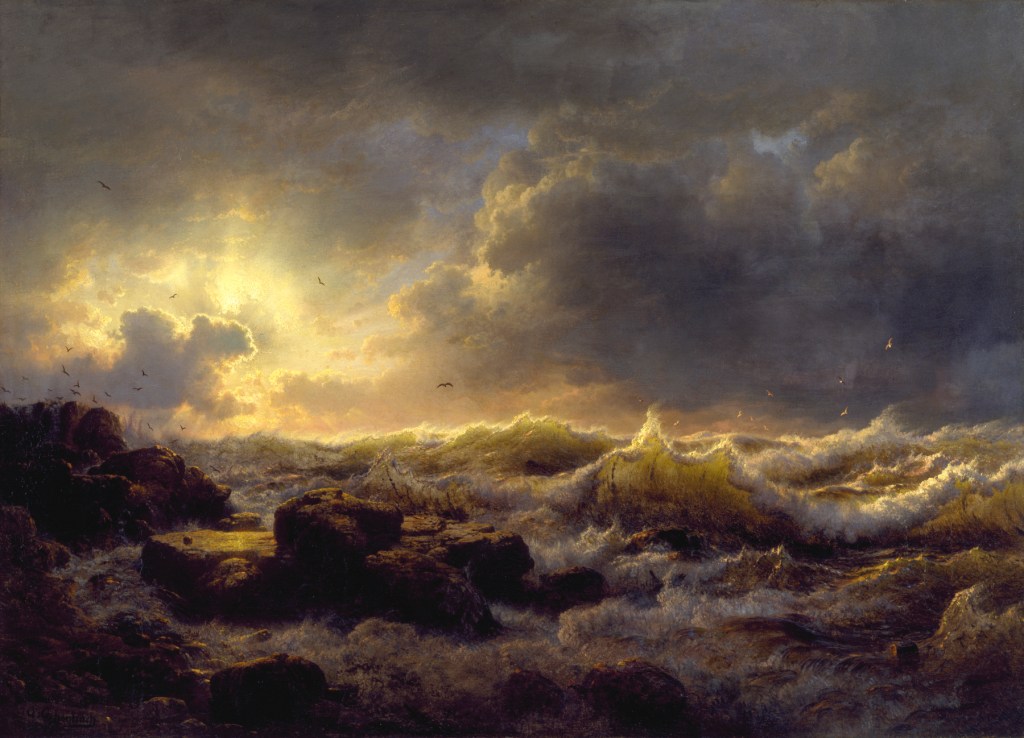
Clearing Up – Coast of Sicily by Andreas Achenbach, 1847
Art is the highest form of human expression — boundless in its potential, infinite in its variety, and unmatched in its ability to connect one to the universe and reveal the interconnected nature of all things. Through art, people communicate their thoughts, emotions, moods, experiences, and values, whether consciously or unconsciously, across time and space. It transcends cultural and linguistic barriers, making it perhaps the purest and most universal form of communication. To create and engage with art is therefore a spiritual act — one that must be approached with intention, presence, and respect. Both the process and the artist must be honored.
The artist holds a sacred space within existence. When one makes art, they are reflecting and channeling the universe’s most essential characteristic: creativity. As local articulations of Ji, we participate in the process of becoming through the creation of art, which can be considered our own uniquely human form of manifestation. Thus, all art has intrinsic worth. It is as central to the sustainment of relational flourishing as any other aspect of civilization and vital for self-expression and understanding.
Art as Ritual
Within Jiayan philosophy, the creation, study, criticism of, and engagement with art is the closest thing to ritual and worship outside of reflection in nature. To encounter art is to actively engage with the thought process and feelings of the creator(s). To create art oneself is to examine one’s own thoughts, feelings, and beliefs and transmit them fearlessly into the world. The art of artistic creation is thus not merely expression, but a form of discipline and cultivation. Art is practice, not product.
The Equality of Forms
No medium or method of art is more or less valid than another. Painting, sculpture, architecture, ceramics, theater, dance, film, literature, music, photography, conceptual art, and interactive forms such as video games (as well as art forms not listed and some yet to be created) all hold equal artistic merit. Even in the crafting of practical tools and everyday objects, there is space for artistry. The applied arts remind us that beauty and function are not at odds but should be inextricably linked.
Art and the Virtues
Art finds resonance with the Ten Virtues. Art records human experience and transmits insight across generations through myths, fables, legends, and the meanings interwoven in popular stories and music (wisdom); it expands communication beyond mere words, restoring symbolic and nuanced expression to human life (right speech); it gives voice to the marginalized, re-balances narratives, and offers access to perspectives otherwise hidden (justice). Finally, the creation and study of art can provide calm reflection, balance, and release from pain (equanimity).
The underlying virtue of mettā-karuṇā is also expressed through one’s engagement with others’ art. To interact with the art of another is one of the deepest forms of compassion, as one places oneself in the position of the creator(s) involved, attempting to understand their motives, feelings, and beliefs.
Communal Resonance
Art reinforces the truth of interconnectedness and the falsity of separateness. It is never solitary: even when made alone, a work exists within a lineage of tradition, materials, and symbols that carry communal resonance. No work of art exists in a vacuum; inspiration flows like a cascading waterfall from one piece to the next. To make art is to join in a conversation across time and space, weaving one’s voice into the infinite tapestry.
Art and Impermanence
The temporal arts of theater, dance, and street performance (even live shows) bear witness to the Jiayan teaching of anicca. No one performance is the same, and each fading note or gesture reminds us of the transience of all things. A work of art is never truly finished. It may be revised and expanded upon by its maker, transformed through reinterpretation, integrated into the wider cultural zeitgeist, responded to and critiqued, analyzed and reexamined for the values it transmits. Art is alive, in continual dialogue with its creator and its audience. Art that fades into true obscurity is likely out of step with Ji.
Integrity and Duty
Art holds value in and of itself, independent of external validation. An artist need not justify their work to others or conform to imposed standards of quality. Yet integrity of process remains essential: artists should resist reducing their craft to commercial transaction, and those who engage with art should avoid treating it only as something to be ranked or dismissed. Art is a deeply personal and spiritual experience — what speaks to one may not speak to another, yet there is something for everyone.
Governments, institutions, and corporations must recognize that art is not a luxury, a pastime, or an industry to be exploited, but one of the most vital forces in human development and understanding. They bear the responsibility of preserving artistic works however possible and should refrain from censorship. No idea or concept should be considered off-limits in art, so long as its creation does not involve suffering. To create or to engage with art is to be as a soothing ripple in Ji’s eternal ocean; a contribution that nevertheless sustains harmony within the Whole. Art affirms beauty, suffering, and connection as inseparable dimensions of existence.
 Jiaya
Jiaya 
Leave a comment