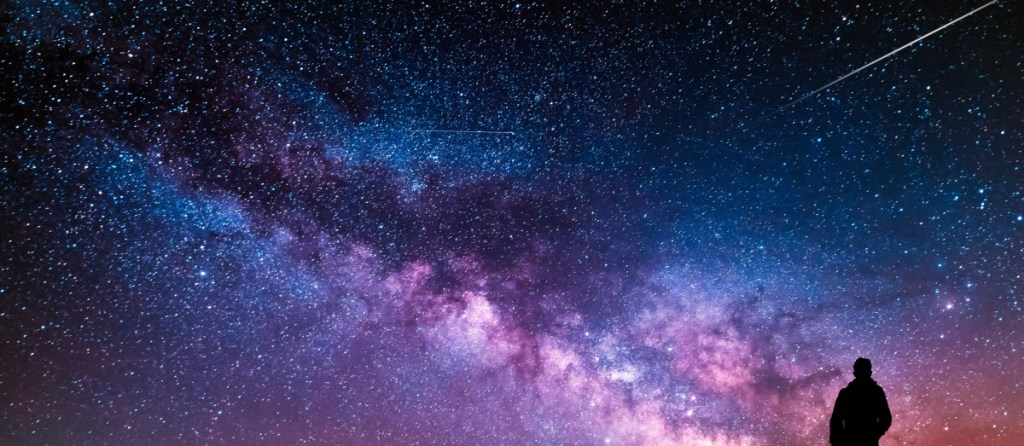
“Through our eyes, the universe is perceiving itself. Through our ears, the universe is listening to its harmonies. We are the witnesses through which the universe becomes conscious of its glory, of its magnificence.” – Alan Watts
The interconnected and interdependent nature of reality affirmed by the Four Principles and the Seven Teachings leads one away from both a strictly theist and a strictly atheist view of the universe. All reality emerges from and participates in the same relational ground, referred to in my writing as Ji. Jiayan teaching holds that deities and the divine, as they have been articulated by various peoples, represent different cultural viewpoints on our Reality; through their differences, they both reflect Ji’s boundless experiential depth and affirm a singular truth..
For the duration of our physical lives, our pneuma could be understood as self-conscious; that is, the universe experiencing itself. What happens before or after this period of physical self-consciousness is not something any of us can claim to know or will likely ever be able to impart to anyone on this plane. Speculating on it is unskillful and distracts from making internal and external progress in the here and now. Instead, we should reflect on our lack of understanding of the before and hereafter as an exercise in humility.
In light of our limitations, we must instead turn our attention toward the beauty we can observe in the present. The realization that all existence comprises a cosmic Unity is incredibly moving, powerful, and awe-inspiring. I believe that which humans have attributed to a monotheistic God over the millennia is this sense of something higher, something ordering the universe, a higher purpose, a destiny, something shaping fate; Ji, Brahman, Tao, or any other suitable name.
Rather than a corporeal deity actively intervening in human affairs — for what are we but specks among the vast multitude of stars — Ji is simply what was, what is, and all that will be. Ji is not separate from the world, but the world itself, manifest in all its glory and permeating every fiber of its being.
It is understandable, therefore, that cultures and peoples over the years have often applied human qualities to their gods. If we are truly part of one great universal whole, then one might expect the divine to look something like us. While this tendency is indeed reflective of the divine within us, depicting God as such serves only to diminish the true majesty of Reality. Divinity is not disserved by lacking a face or voice — we see it through the rhythms of time, the patterns of nature, and the moral arc of history which bends toward greater harmony as we align ourselves with the cosmic standard.
Through recognition of the infinite oneness of all things, we understand and comprehend that we are called to love all things, for all things are ourselves and should be treated as such. The entire universe is predicated on a divine principle, thus we share in its divinity. By embodying virtue and demonstrating compassion, we act in accordance with Ji’s integrative nature and ensure it remains in equilibrium. To live in harmony with Nature is to see no boundary between self and world, no division between matter and spirit. To love the universe is to love the self and to love the self is to serve the universe.
 Jiaya
Jiaya 
Leave a comment