“All flows out from the Deity, and all must be absorbed in Him again.” – Zoroaster
Frashokereti is the Zoroastrian term used to refer to the end of times, in particular the final restoration of the universe to its original state untainted by evil. While eschatology is not a topic that Jiaya concerns itself with, frashokereti parallels and begets central Jiayan concepts in significant ways. This becomes clear once we peel back the veil of religious imagery to focus on the philosophical messages beneath.
When comparing frashokereti with Jiayan concepts, it’s important to keep in mind that religions like Zoroastrianism are not inherently incompatible with Jiaya; their theology reflects an earlier, more mythic interpretation of the universe. Histories were crafted based not on rigorous study of primary and secondary sources but a confluence of religion, myth, folklore, oral tradition, and reliable documentation. Narratives were valued more for the ideas and teachings they transmitted rather then their factual content. Thus, in a Jiayan context, it’s necessary to view religious stories through the lens of moral poetry.
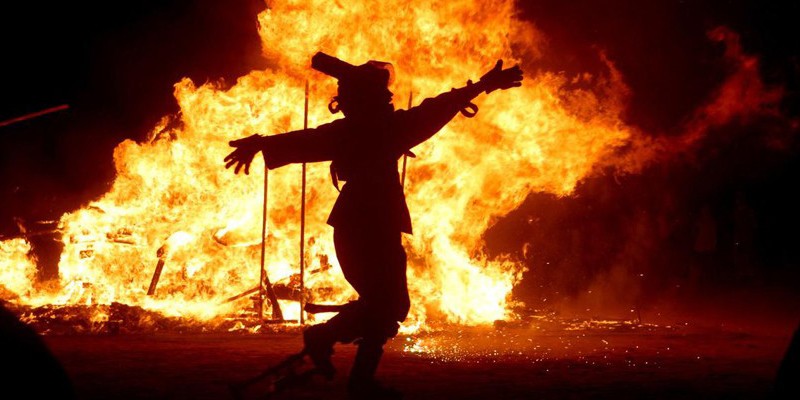
As one might expect, frashokereti finds commonality with the Jiayan teaching of apokatastasis. Jiaya teaches that all things, all beings must eventually be reconciled with Ji. A being out of step with Ji, one who is mired in egoistic disharmony, would not be able to pass into the cosmic weave easily upon their death. The method of one’s reconciliation is ultimately unknowable to humans who may only be able to perceive but a fraction of the cosmos’ true nature. Frashokereti, like many other religions, uses the metaphor of cleansing fire or ātar, to describe the process of purification.
The nature of most religious stories and myths necessitates an end, a conclusion in which good reigns victorious. And so too goes the story of Zoroastrianism in which, at the end of frashokereti, all evil, and even hell itself, is ultimately destroyed in the holy fire. Such stories are necessary as they provide hope and a goal for humanity as a collective to strive for: a future in which people are ultimately free from worldly concerns and fears. While Jiaya does not teach that such a future will occur, for the nature of Ji is cyclical, it does share the sentiment that universal epektasis and complete alignment with Ji is the final goal for all things.
However, while it’s true that Zoroastrian texts seem to treat the frashokereti as a foregone conclusion, they also put significant power in the hands of humanity to bring that future about, a striking similarity with the Progress Principle. The continual striving of individuals towards good thoughts, good words, and good deeds is what ultimately brings about frashokereti. Both propose a cooperative destiny through which the divine order is perfected through ethical participation.
Zoroastrianism is a dualistic faith, one that teaches that good and evil are diametrically opposed cosmic forces, both existing from the beginning, that battle it out through the actions and choices of each person. On the other hand, Jiaya teaches that the universe is good by its very nature and that “evil” is a product of disharmony and its unskillful consequences wrought by humanity. Of course, one could argue that from a human perspective, both good and evil did very much both exist “in the beginning,” and so Zoroastrian teaching is true in that sense. That said, in a way, through frashokereti, a Jiayan-style monism is achieved through the purification of this evil force.
Zoroastrian teaching of this post-frashokereti period is aligned with Jiayan conceptions of future goals if humanity is to align further with Ji. All people live without hunger or thirst, conflict is non-existent (both of these are idealized representations of Jiayan governance), borders have been eradicated, and notably, diversity is affirmed. While frashokereti restores the universe to how it existed at the time of creation, all diversity that arose since that time remains (except for language which ancient peoples may have found a frustrating barrier to coexistence).
The similarities between frashokereti and Jiayan teaching are critical to note because they reveal a shared human intuition: that existence, despite its struggles and imperfections, bends toward restoration. For Zoroastrianism and most other faiths, this manifests as the culmination of divine history; for Jiaya, it is the nature of Ji expressing itself through progress, renewal, and reconciliation. That such wisdom goes back millennia hints at how humanity relates to the universe and its own destiny.
 Jiaya
Jiaya 
Leave a comment