“Our posturings, our imagined self-importance, the delusion that we have some privileged position in the Universe, are challenged by this point of pale light. Our planet is a lonely speck in the great enveloping cosmic dark.” – Carl Sagan
One of my favorite parables is that of the blind men and the elephant. Its truth has resonated so deeply for different peoples across different contexts that it has shown up in varying forms in several traditions, from Jainism and Buddhism to Sufism and Bahá’í.
It’s a short story, as parables are, but an incredibly effective one, its content demonstrating a profound wisdom and understanding of the nature of reality. To make a short story even shorter, the blind men seek to determine the nature of an elephant. Given that they’re, well, blind, they can only know so much about the creature and come to erroneous conclusions, however, based on their limited knowledge, what they perceive appears to be correct.
I took this generalized version from the Wikipedia page on the parable:
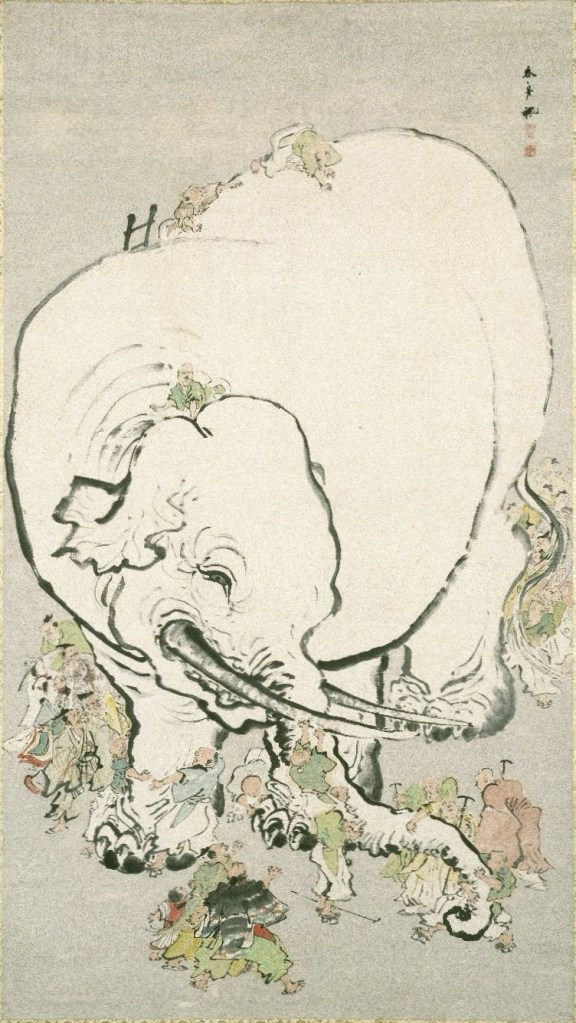
A group of blind men heard that a strange animal, called an elephant, had been brought to the town, but none of them were aware of its shape and form. Out of curiosity, they said: “We must inspect and know it by touch, of which we are capable”. So, they sought it out, and when they found it they groped about it. The first person, whose hand landed on the trunk, said, “This being is like a thick snake”. For another one whose hand reached its ear, it seemed like a kind of fan. As for another person, whose hand was upon its leg, said, the elephant is a pillar like a tree-trunk. The blind man who placed his hand upon its side said the elephant, “is a wall”. Another who felt its tail, described it as a rope. The last felt its tusk, stating the elephant is that which is hard, smooth and like a spear.
In some versions of the story, the men fight each other over their differing conclusions about the elephant, an obvious commentary on how ideological, religious, and cultural differences can arise out of ignorance and delusion.
There are a couple readings of the parable that stand out to me as strongly aligned with Jiaya. My first instinct was to view each of the blind men as a follower of a different religion, faith, what have you. Each man was raised in a particular cultural context and has been conditioned to believe that their of how things work is objectively correct. Yet none of the men on their own has the complete picture. Only by working together and sharing with each other the knowledge they’ve ascertained can they reach the truth, or get as close to it as one possibly can.
The versions of the story in which the men become violent represent the tribalism, separatism, and dogmatism of religion. The elephant represents Ji, Reality itself. All cultures and traditions have elucidated aspects of the One in some way and to insist one view is right over all others is to only see one part of the elephant. It represents a disalignment with Reality.
The other reading I thought up as I contemplated the parable concerned the extent of human knowledge. I believe that, to a point, the blind men serve as a stand-in for humanity as a whole, and the elephant the cosmos. Humans perceive Reality through the limited channels of their senses and technology. There will always be things humanity will never fully grasp about the universe due to our inherently limited nature, and to assume otherwise is the height of arrogance.
The cosmos does not withhold answers; quite the contrary, for discovering and learning about universal laws is a noble venture that leads to greater well-being for all (see: Right Livelihood). Yet it is important to recognize our place within all things to avoid hubris and the development of unskillful views. When we encounter mystery, embrace it with reverence and wonder and remember that each new discovery uncovers but a part of the elephant.
 Jiaya
Jiaya 
Leave a comment