“It was so much easier to blame it on Them. It was bleakly depressing to think that They were Us. If it was Them, then nothing was anyone’s fault. If it was Us, what did that make Me?” – Terry Pratchett
The recent resurgence of conspiratorial thinking, its international spread facilitated through social media algorithms that boost extremism, presents a corrosive threat to society’s political and moral attentions.
Rather than confronting visible, ongoing crises we face like war, systemic human rights abuses, democratic backsliding, and climate collapse, many people have become content to redirect their energies online toward alleged shadow cabals that control…everything, if that were even possible. It is yet another byproduct of the lack of meaning and certainty that we find in global society today and it further undermines trust in our communities. The consequences could be disastrous if we allow a mob-like Inquisition effect (see also: Salem witch trials, McCarthyism) to take hold.
At its core, conspiratorial thinking seeks moral simplification. Complex social systems that are the result of a multitude of historically convergent factors are reduced to the fictional binary of good vs. evil, holy vs. demonic. Structural injustices tend to be ignored in this conception of reality. Individuals and groups are no longer evaluated by their actions, contexts, and consequences but essentialized as either purely good or purely evil. There’s no place for nuance in such a worldview. Emotional clarity makes things simple, nice, and manageable while nuance invites contemplation, consideration, and careful study of facts.
As I just alluded to, more often than not, the dichotomy of good and evil is taken to a metaphysical extreme. All reality becomes a cosmic, spiritual battlefield in the Zoroastrian mode (co-opted by modern evangelical Christians) in which those on the side of Christ are aligned with nationalism, heterosexuality, purity, and whiteness while those on the side of Satan — a figure even many Christians don’t view as literal — are aligned with globalism, homosexuality, pedophilia, multiculturalism, and of course, Judaism.
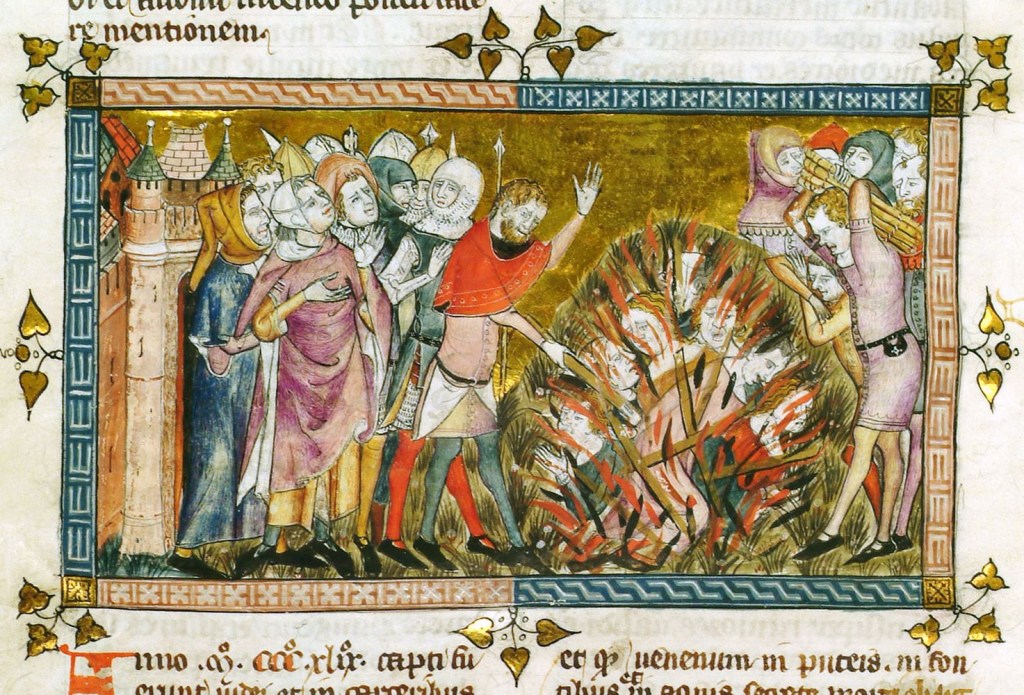
These are battles that have been waged before and not in the distant past. In the 1980s, the Satanic panic surged in North America. While it originated from an account brought on through the discredited practice of repressed-memory therapy, it would be unfair to put the blame squarely on quackery. The targets of the panic — music, education, television, child care, and games — reveal the true cause: the loss of WASP hegemony over “western civilization.” The originators of such panics concoct the most morally repugnant accusations they can think of: those of child sexual abuse, sex trafficking, and human sacrifice. And they’ve all been used in previous smear campaigns against “the others” in history in attempts to remove them from society, through genocide if necessary.
Historically and in the present, conspiracy theories have been used to scapegoat Jews, religious and ethnic minorities, migrants, and other vulnerable populations. Attributing malevolent power on an implausible scale to the out-group conceals the true nature of power and responsibility in society. It absolves the conspiracy’s propagators (“Oh well. There’s nothing I can do because there’s a secret group controlling everything”) and protects the truly corrupt by shifting blame to the vulnerable. In other cases, blame is shifted not to the vulnerable but to political opponents (or both) to consolidate power and throw the public off the scent.
Powerful individuals do coordinate, speculate, and exploit instability for profit. That reality is neither secret nor metaphysical; in fact, it’s exactly how you’d expect things to function in an unequal, capital-centric society. The fatal flaw of conspiratorial thinking lies in its transformation of limited, contextual wrongdoing into a total explanation of the world. The analysis of systems, incentives, and institutions is sidestepped, replaced with narratives of omnipotent enemies, whose control over the world we’ll never fully grasp. This framework allows us to sever our moral duties to others guilt-free: why help others? It’s a dog-eat-dog world where no one cares about us.
Such myopic theories also appeal to those who feel lost and left behind by society. The desire for a secret knowledge and the belonging gained from being part of an exclusive number aware of the true workings of the world provides a boost of self-confidence and a sense of grandeur and superiority, counterbalancing the feelings of powerlessness and alienation that can arise in the face of rapid globalization. The loss of familiar structures and natural cultural changes is reframed as a sinister plot orchestrated by a select few rather than a confluence of dependent factors.
Fear underlies the conspiratorial mindset. Fear of change, moral ambiguity, uncertainty, and especially, losing status in an increasingly interconnected world. By collapsing complexity into digestible simplicity, conspiratorial explanations provide emotional relief. Intellectual relief is granted too, for they do away with any notion of critical thinking. If all problems can be blamed on a single omnipotent group, the solution is clear: remove the group and no more problem; utopia is achieved. Of course, reality doesn’t work that way as any such effort throughout history has shown.
Conspiratorial thinking is not merely incorrect; it is regressive. Ethical responsibility turns to paranoia, inquiry becomes accusation, and present action is reduced to apathy towards the state of things. In a time when our interdependence is clearer now than it has ever been, the problems humanity faces are visible and urgent. Retreating into tribalist mythmaking is a moral failure and solves nothing.
The truth is that the good work needed to rectify injustice is a lot more complex and less fantastical than unmasking a bunch of villains Mystery Inc.-style. It requires presence, attention, solidarity, unity, and willingness to act within our shared reality rather than retreating into the imagined world of moral duality.
 Jiaya
Jiaya 
Leave a comment