Ji is the central concept that underpins Jiayan philosophy or thought. It’s important to have a good grasp of it before delving into anything more jargony.
Put simply, Ji is what makes reality possible. Think of it as the structure that underlies all things. From Ji, existence emerges. Ji is not a thinking or feeling entity, but the manifestation of reality comes natural to it (hence the existence of our universe), rather like thoughts and actions arise naturally within us.
Ji is not a god. It did not consciously create the universe. It is not a being with any sort of will or intent. Whenever such ideas are hinted at or used in my writing, it is metaphorical; poetic license. Anthropomorphism can help us better understand Ji‘s attributes, which is why I believe so many cultures and traditions around the world have ascribed human (and also, non-human animal-like) characteristics to gods. But it should not be construed as an adequate reflection of reality.
Everything that exists, from stars to life, to sensations and thoughts, are local articulations of Ji through a spectacular process of creative unfurling, from which sapients like ourselves can derive meaning. Yet, the unique components of Ji are not the universe’s material, but the moments and experiences in time that unfold within it. From the binding of two atoms to a fleeting emotional reaction or a distant supernova, the universe is made up of experiences that impact all others in incalculable and subtle ways.
Jiaya is, first and foremost, about understanding and accepting this interconnection. When we realize that the universe is not made up of competing individuals but interdependent and emergent reflections of one another, we recognize that we are called to act in accordance with our reality’s dependent structure: to live with awareness, compassion, and responsibility. To resist this leads to fragmentation and invites suffering, whether internally or externally.
Two Metaphors
There are a couple metaphors I’ve developed to illustrate the concept of Ji in a more poetic fashion. The first is the ocean. Not any particular ocean, just a vast body of water.

Ji in its unmanifested aspect, if such a thing is possible, can be imagined as an ocean in complete calm. No waves, no ripples, no visible movement, nothing. Ji is not empty; there is still the potential for…something. In this ontological before state, the water rests in undifferentiated stillness.
Manifestation (whether in the form of a universe or something else entirely) can be understood as movement within the ocean. Waves begin to form and tides rise and fall. Where was there was a total silence, now there is noise. Nothing has been added to the water itself. The substance remains the same; only its patterns have changed.
I think many have noticed that water has a sort of breathing quality as it moves from high tide to low. It’s sort of like the Earth inhaling and exhaling. It never reaches the shore in exactly the same way twice, but it follows recognizable rhythms. It does not repeat, but it rhymes. Another reason the ocean metaphor works so well.
As Ji differentiates into increasingly complex articulations (think stars, planets, nebulae, and perhaps sentient life), even more ripples begin to appear. The ocean is now constantly in motion. Each wave and current affects the others, though the influences may be distant, subtle, and non-perceivable to us.
The emergence of sapient beings like ourselves brings the capacity for disalignment. Fragmentation (what occurs when we don’t live in harmony with the universe’s structure) can be likened to the formation of increasingly large and destructive waves. These waves threaten to disturb wider parts of the ocean the more they grow. Flourishing, by contrast, does not introduce anything of the sort. It is like a wave that moves in complete coherence with the tide; seamless, integrated, indistinguishable. In the proper circumstances, one may not even notice that anything different had even happened.
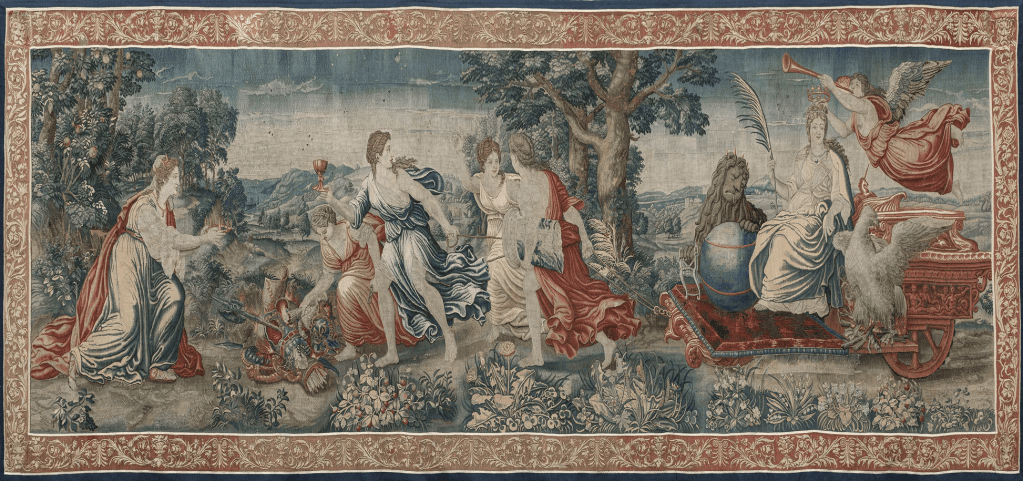
The second metaphor is Ji as tapestry. Not a complete tapestry nor a tapestry that is being woven by a weaver, but a tapestry weaving itself through a process we will never comprehend. Ji cannot be understood as any one particular thread. It is all parts of the tapestry — the fabric, the loom, and the pattern all at once.
Each occasion of experience in the universe could be viewed as a stitch within the tapestry. Each sensation and thought is woven into the vast fabric, but stand from a distance and one will only see the whole. Pull one strand and tension redistributes throughout the entire piece. No thread exists independently for each gains its shape and direction through its relation to the others.
The tapestry is most adept at representing Ji‘s creativity. New patterns emerge as the threads intersect in novel ways. One part of the tapestry may look “basic,” another may look “vibrant” and “intricate.” It all depends on how the threads connected in any one moment.
Sapient beings represent a unique kind of thread. This thread has, for better or worse, gained awareness of its thread-ness. If it recognizes its position as part of the vast, interconnected tapestry, it has the potential to create a truly beautiful section. It can fully cohere with the design and greatly expand its experiential depth. If the thread were to reject this and view the tapestry as more of a playground where it can do whatever it wishes, knots and fraying are bound to occur. Eventually, the design in that section will become so incoherent that the tapestry may self-correct.
Both analogies demonstrate that we are not isolated entities. Whether strands in a tapestry or droplets in the ocean, we exist as diverse, unique expressions of a single, unfolding existence. To live in harmony with Ji is to understand reality for what it is and to use our lives to better our universe in whatever way we are able.
 Jiaya
Jiaya 
Leave a comment