“A sign of intelligence is an awareness of one’s own ignorance.”
– Niccolò Machiavelli
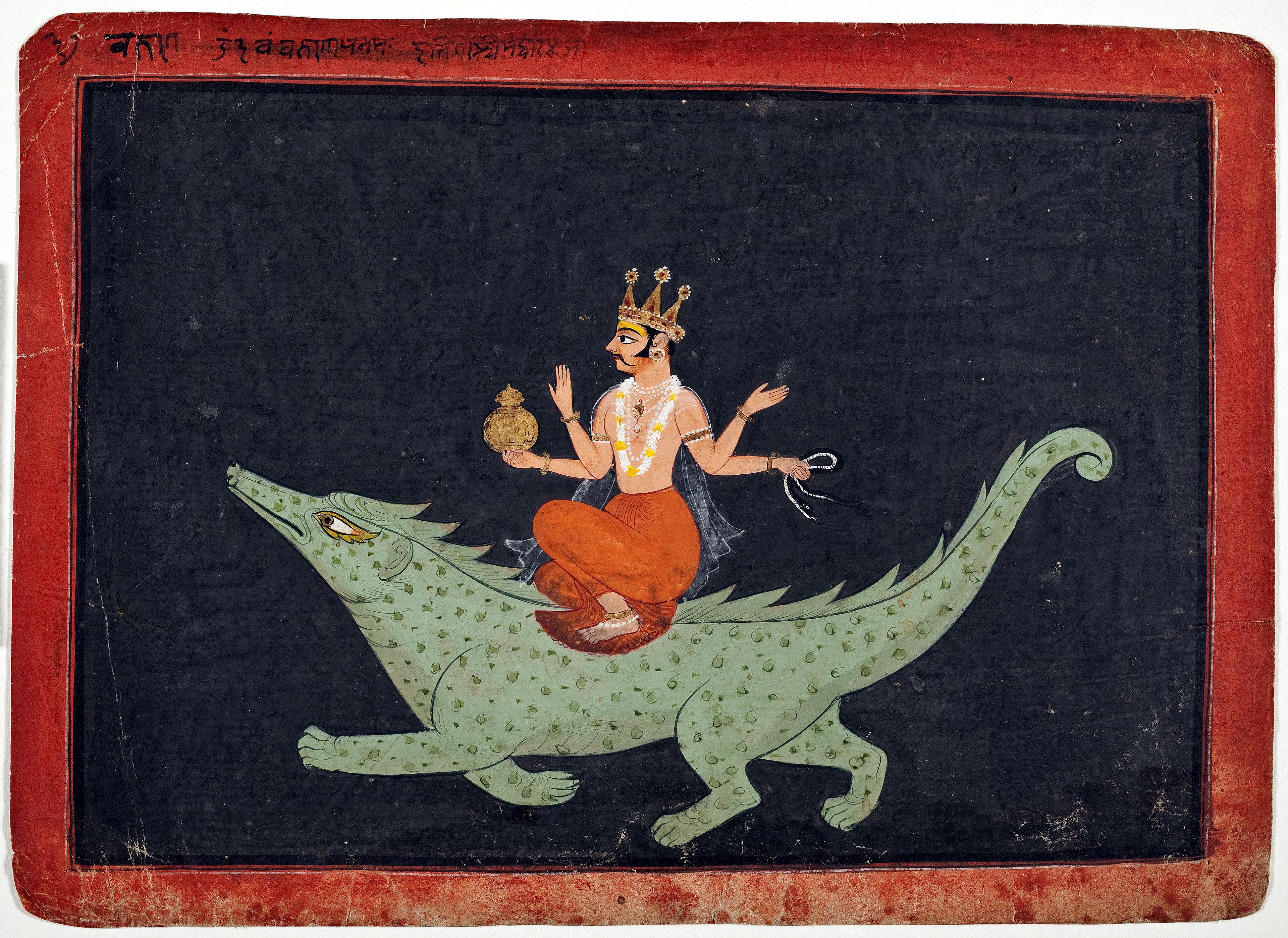
Watercolor of Varuna, artist unknown, c. 1675
Jiayan teaching puts forward a number of claims or statements on the nature of Reality. While all are key to understanding the way in which our universe works, they operate across different levels. Think of Jiayan claims as a sort of pyramid. At the bottom rest its most central claims. If any of those are proven to be false, however unlikely that may be, the entire philosophy collapses in on itself. At the top rest questions on Reality that Jiaya recognizes as mystery and potentially unfalsifiable, therefore unworthy of coverage in writing. They do not invalidate the philosophy if disregarded entirely.
In its current form, Jiaya holds all statements in tiers 1 and 2 to be true until proven otherwise. The empirical foundation of the first tier is given meaning by the philosophical commitments of the second.
Tier 1: Empirical
Claims in this tier rest on observable evidence and stand or fall according to their coherence to that evidence
- All things are interconnected and participate in the same relational ground. Relationships between ecosystems, physics, and human social systems affirm this truth.
- The boundaries between self and other are illusory (anattā). The most recent neuroscience and cognitive science backs a constructed, permeable selfhood.
- Actions that reduce harm and strengthen relational coherence (the degree to which social structures and individuals recognize and act in accordance with interdependence) tend to sustain integrative vitality (continued existence). This is observable in historical and social patterns; states that favor dominion do not last.
- Tribalism (defined in a Jiayan context as prejudicial attitudes and discriminatory behaviors towards an out-group and refusal to engage with others unlike oneself) and injustice generate destabilizing consequences in the long term.
- Every event shapes subsequent events all the way back to the universe’s origin in a phenomenon called causal inheritance.
- A life’s causal inheritance persists after death; what is known as objective, rather than subjective immortality.
- Democracies have demonstrably produced better outcomes in human rights, stability, and flourishing than authoritarian alternatives across documented history.
- Comparative religion and anthropology document convergence across traditions on themes of interdependence, impermanence, compassion, and the unfulfilling nature of ego-centered living.
Tier 2: Philosophical
Claims in this tier draw conclusions from the empirical observations. What do truths about our universe potentially say about the nature of existence?
- Ji’s integrative nature constitutes a structural orientation towards coherence. This is based upon Nature’s tendency to heal or self-correct over time. Jiayan philosophy’s assertion that this happens in most, if not all, cases of fragmentation puts the claim in this tier.
- All existence has intrinsic worth by virtue of participation in the relational web. This is a value commitment consistent with empirical reality, but not an empirical claim in and of itself.
- Prehension’s extension from causal inheritance to experiential inheritance (that is, the claim that causal occasions carry an interior dimension) and panexperientialism (the claim that all matter has some rudimentary form of existence) is a response to the hard problem of consciousness neither confirmed nor refuted by current science.
- Jiaya’s teaching of apokatastasis, a belief in the eventual reconciliation of all disharmony within Ji, is a philosophical interpretation of the first claim in this tier.
- Jiaya philosophically infers from convergence across traditions that world religions and faiths are diverse cultural articulations of the same underlying reality (to which Jiaya ascribes the name Ji).
- While behavioral modernity (the gradual development over many thousands of years of abstract thought, planning depth, cultural evolution, art, and lithic technology) was indeed a turning point in human development, Jiaya goes a step further and identifies it as the origin of cosmic disalignment, while recognizing its fruits.
Tier 3: Speculative
Only speculative answers can be given to the areas listed here. While I may occasionally hint at my subconscious preferences on these topics in my writing, they are not meant to reflect canonical Jiayan teaching. Fruitless speculation on these matters is unskillful.
- Nature and scope of apokatastasis as it applies to sapient begins after death
- Nature of consciousness and experience in its most rudimentary forms across all matter
 Jiaya
Jiaya 
Leave a comment