“Our self is māyā where it is merely individual and finite, where it considers its separateness as absolute; it is satya where it recognizes its essence in the universal and infinite, in the Supreme Self, in paramatman.”
– Rabindranath Thakur
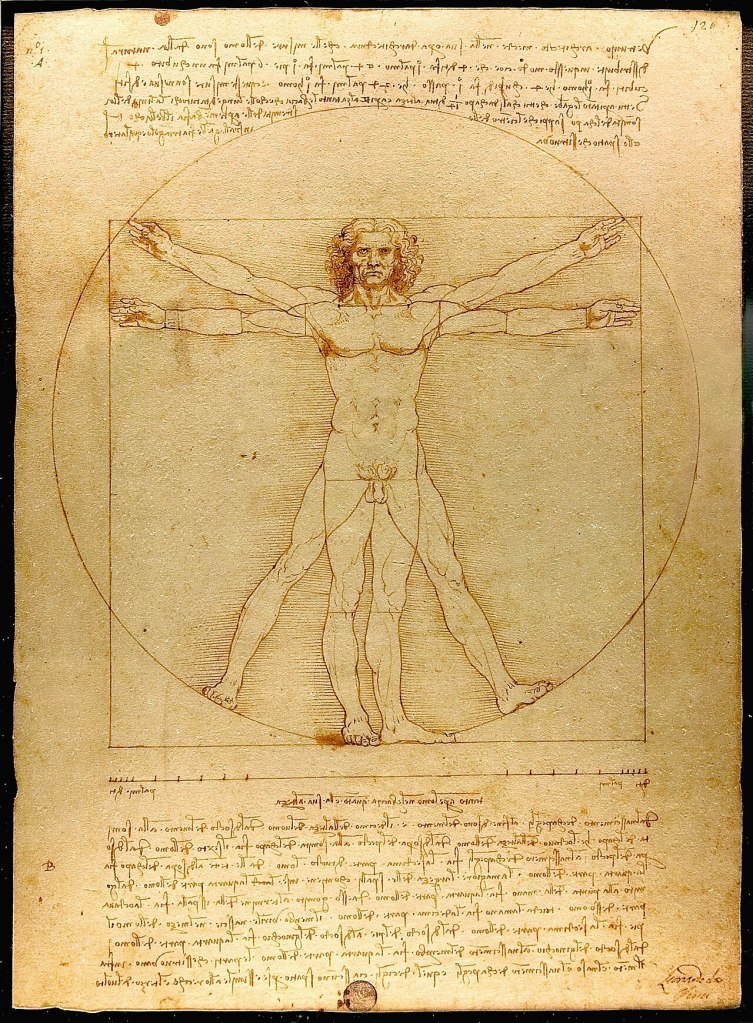
Vitruvian Man by Leonardo da Vinci, 1490
The conflict between the atomistic and relational self is cultural as well as internal. In the West, particularly since the Enlightenment, we’ve been trained to see ourselves as distinct individuals separate and apart from all that exists. In India, Southeast Asia, and East Asia (regions heavily exposed to the Dharmic religions), conceptions of the self take a more relational form. The “self” (whether it exists or not depends on the tradition) is inseparable from the community. The effects of one’s actions reverberate through the greater web of reality.
The sentiment that we are not of this world might sound familiar to any practicing Christian, and it’s one that easily arises from our conditioned individualist view of reality (whether or not it actually aligns with Christian teaching is beside the point here). If humans are universal anomalies, what do we owe to the rest of the world? The runoff from this mindset is the selfish corporatism we are saddled with today; a triumph of egoism.
Unfortunately for us in Western civilization, this line of thinking epitomizes wrong view. And not just spiritually, but scientifically. The notion of concrete bodies or structures that exist separate from that which surrounds them is useful in a colloquial descriptive sense (e.g. “that is a dog”) but not useful if we want to truly properly discern the nature of reality, or at least as best we can.
Where do the molecules that make up the dog in question begin and end? The simple truth of the matter is that there is no real answer, nor is there an answer for any such “thing” in the universe. Existence’s most basic particles are always in constant flux and the appearance of constant, solid things is but an illusion. Labels are necessary of course, but we must be cautious of them insofar as they lead us to see ourselves as actors insulated from universal processes.
While researching for this write-up I found a book called “Your Atomic Self: The Invisible Elements That Connect You to Everything Else in the Universe” by Curt Stager. Despite the title (I changed mine from “atomic” to “atomistic” because of it), his writing seems to align much more closely with a relational self which is no surprise considering his scientific background.Take this quote for example:
“…atomic motions cause the waxing and waning of rivers, so too do they produce the transient body that you—whatever “you” means—currently inhabit before its substance flows back into the great global sea of atoms. Consider, then, the particles that are departing your body at this very moment. There is no need to wait for death to scatter you to the winds, waters, and soils of the world. It is already happening.”
The atomic sea in this passage sounds rather like an analogy I used for Ji, in that we may think of ourselves as but waves or ripples in the ocean that is Ji. The final two sentences on death resonate strongly with Buddhism’s dependent origination.
A close study of reality reveals its true nature: that there is really no “I” or “me” or “you.” There only exists all things. The universe’s interdependent structure mandates our action in reducing suffering. Indifference to harm or outright inflicting it reflects a grave misunderstanding of the world: it presupposes a permanent, egoistic self where there exists only ephemerality. Align one’s thinking to reality and thoughts of clinging will be tempered.
 Jiaya
Jiaya 
Leave a comment