“Study the past if you would define the future.” – Kǒngzǐ
Henosian Periodization (derived from the Greek henosis, meaning “oneness,” “union,” and “unity,” and often associated with the concept of the Monad or the One) is a system of periodization that organizes the history of humanity into distinct Ages that reflect its cultural, moral, and technological evolution.
Henosian Periodization is intended to map the development of humanity along the lines of the Progress Principle. It reflects humankind’s journey toward unity and understanding, embodying the Jiayan recognition in the interconnectedness of all beings. It offers a more intuitive and unified framework for understanding humanity’s shared journey.
Proposed Ages
As technology advances and the world continues to globalize, the length of each Age has become progressively shorter. This pattern could be reversed if humanity unites as one, ushering in an era of eudaimonia.
The Archaic Age
3.3 million – 315,000 years ago
Length: 3.3 million years
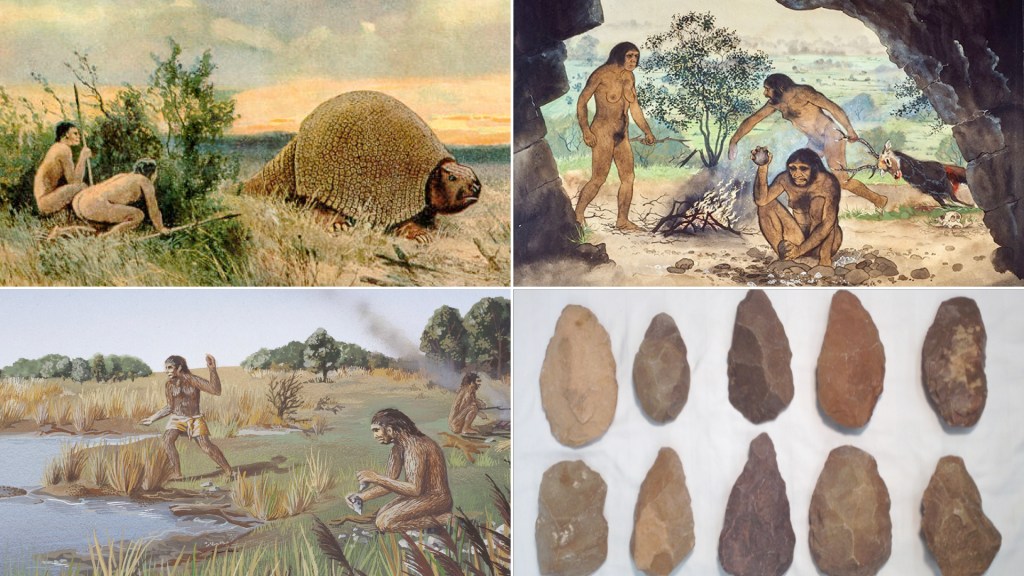
This Age is characterized by:
- The emergence and diversification of early hominins across Africa
- The lifestyle shift in Homo erectus from that of scavenging to hunter-gatherer societies
- The development of lithic technologies, notably the Oldowan and Acheulean tool traditions
- The expansion of hominin cognitive capacities related to planning and learning
- The emergence of proto-cultural behaviors including the use of fire, symbolic communication, healthcare, and the first burials
- A closer relationship between humans and the natural world. Violence and inter-group conflict is present, but the question of human sapience is up in the air at this point, ergo such acts are within the bounds of cyclical necessity rather than morality
Significance of start date: The oldest known stone tools were made in Kenya around 3.3 million years ago, by either Australopithecus afarensis or Kenyanthropus platyops.
The Wandering Age
315,000 years ago – 9700 BCE
315,000 years ago – 301 HE
Length: 303,300 years
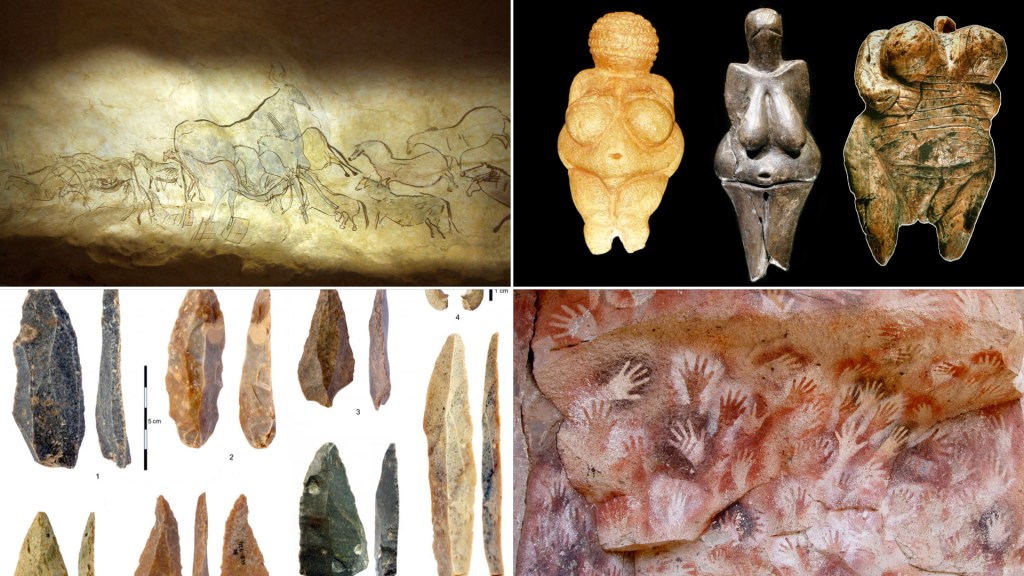
This Age is characterized by:
- The emergence of Homo sapiens from the species Homo heidelbergensis, and their gradual replacement of archaic humans
- The gradual development of behavioral modernity, encompassing complex language, ritual activity, symbolic behavior, and abstract thinking
- The expansion of Homo sapiens both out of and back to Africa on two separate occasions due to megadroughts, arriving in Eurasia 125,000 years ago, Australia 65,000 years ago, and the Americas 15,000 years ago
- The first significant artworks on cave walls, clothing, and the creation of musical instruments, as well as the earliest spiritual practices
- The use of highly sophisticated stone tools that enhanced humans’ ability to manipulate the environment, exploit new food sources, and survive in harsher climates than before
Significance of start date: The first Homo sapiens fossils found in Morocco date to 315,000 years BP or roughly 313,000 BCE.
The Agricultural Age
9700 BCE – 3300 BCE
301 HE – 6801 HE
Length: 6,400 years
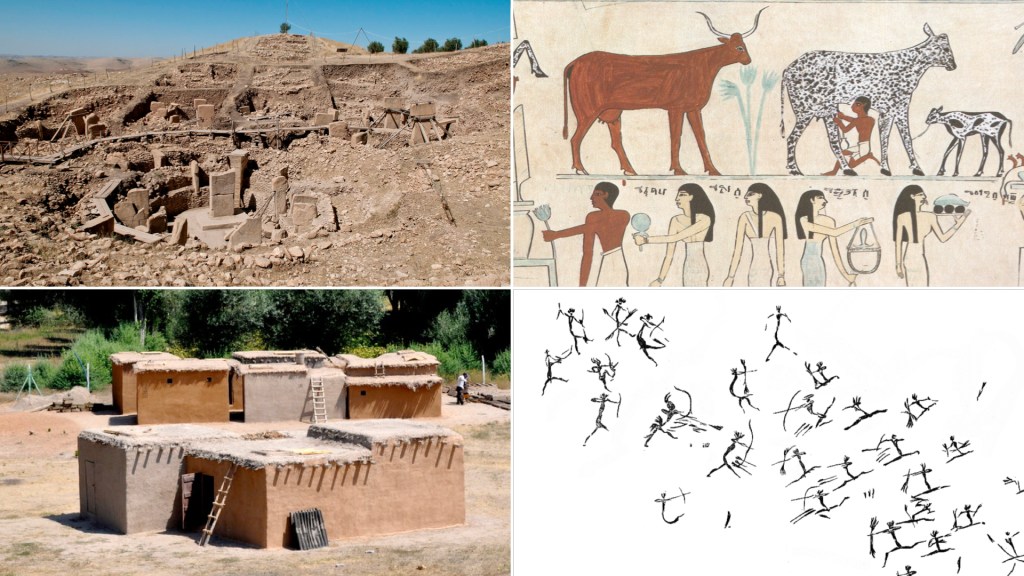
This Age is characterized by:
- The emergence of agricultural communities in the Levant, Mesopotamia, the Yellow River Basin, the Indus River Valley, the New Guinea Highlands, Mesoamerica, and the Andes
- The beginning of the widespread domestication of plants and animals to serve human purposes and the subsequent development of animal-borne infectious disease
- The creation of permanent settlements and complex village networks, giving rise to surplus-driven social stratification and coordinated labor. For the first time, the structural conditions enabling disalignment with Ji are possible. However, humanity’s moral and creative capacities are likewise expanded, allowing for future realignment
- The development of large-scale food storage and pottery traditions that support population growth and long-term planning
- The rise of political cooperation, as seen in the construction of large religious complexes and megaliths, and interpersonal conflict in the form of warfare
Significance of start date: The beginning of the Age coincides with the end of the Last Glacial Period and the beginning of the Holocene geologic epoch, during which planetary conditions for human flourishing became more favorable.
The Sovereign Age
3300 BCE – 1100 BCE
6801 HE – 8901 HE
Length: 2,200 years
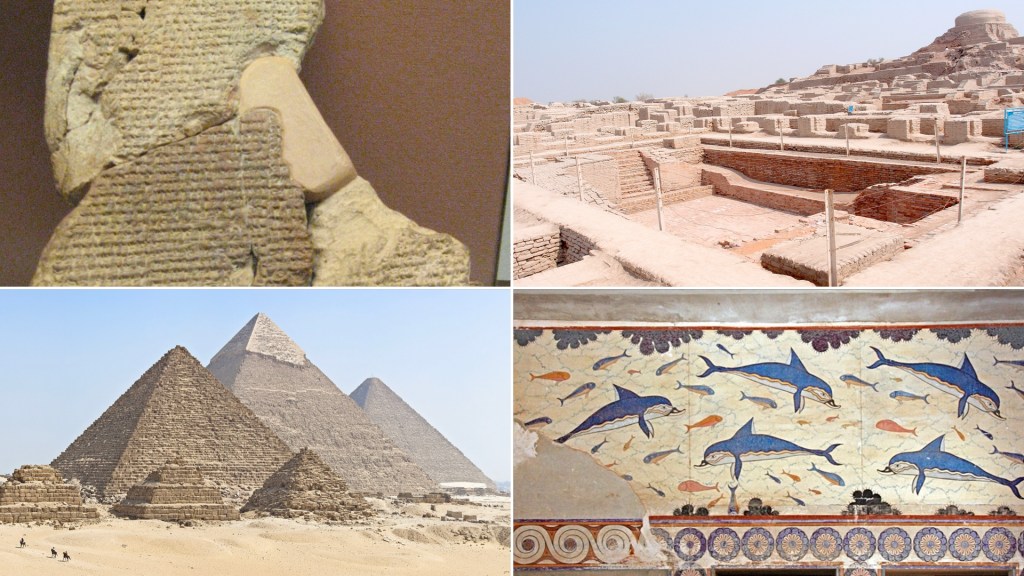
This Age is characterized by:
- The development of the earliest states and polities in Mesopotamia, the Iranian Plateau, Northern Africa, the Indus Valley, the Yellow River Basin, the Aegean, and the Andes, each marked by centralized authority and administrative institutions
- The invention and spread of writing systems, e.g. cuneiform and hieroglyphs, enabling record-keeping, law, literature, and creating class distinctions between literate and illiterate
- The expansion of metallurgy, particularly bronze, which not only revolutionized everyday tools and agricultural implements, but dramatically raised the scale of organized warfare as well
- The construction of the first monumental architecture, e.g. ziggurats, pyramids, palaces, and defensive fortifications, reflecting cooperative and coercive labor and increasingly complex spiritual beliefs
- The formation of the social divide and othering between urban and rural communities, exacerbating humanity’s disconnect with interdependence
Significance of start date: 3300 BCE is traditionally considered the start of the Bronze Age as it relates to Asia and Europe. The early dynastic periods in Mesopotamia and Egypt soon followed, as well as the first civilizations of the Andes and Indus Valley.
The Axial Age
1100 BCE – 600 CE
8901 HE – 10600 HE
Length: 1,699 years
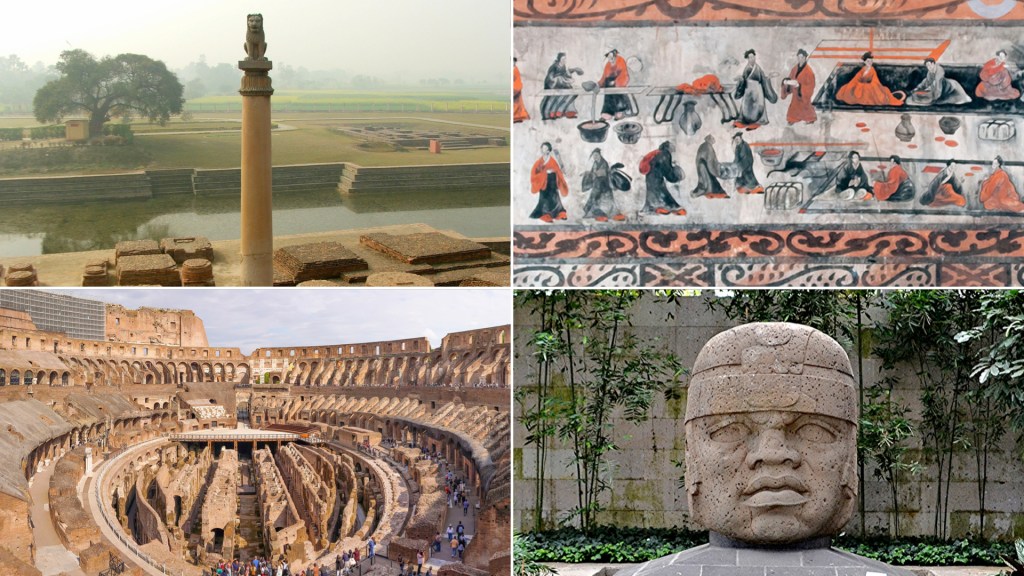
This Age is characterized by:
- The emergence of transformative philosophical, ethical, and religious traditions across Eurasia, including but not limited to Confucianism, Taoism, Buddhism, Jainism, Hinduism, Zoroastrianism, Judaism, Greek philosophy, and Christianity, all of which reoriented human reflection toward moral duty and personal cultivation while also being twisted in service of self-serving motives
- The consolidation and expansion of large imperial states such as the Neo-Assyrian Empire, Achaemenid and Sasanian Persia, Maurya and Gupta India, the Zhou, Qin, and Han Chinese dynasties, Rome, Carthage, Ptolemaic Egypt, Aksum, and Teotihuacan, whose administrative systems and infrastructural projects unified diverse populations under centralized yet often unstable authority
- The growth of literacy and scholarly institutions, including the spread of alphabetic writing in West Asia and South Europe, and the establishment of great libraries, academies, and monastic institutions, which facilitated unprecedented preservation and diffusion of knowledge
- The intensification of long-distance overland and maritime trade networks, particularly through the Indian Ocean and Red Sea, Roman-Kushan land routes, and the Hopewellian exchange, linking peoples through the exchange of goods and ideas that reshaped cultural and economic life
- The deepening of social stratification through slavery and caste systems which served to entrench hierarchy and further distanced humanity from perceiving its inherent interdependence
Significance of end date: Sometimes the endpoint, rather than the start, is how the boundaries of an Age are determined. 600 CE was chosen as the end of the Gupta and Western Roman Empires, the re-unification of China under the Sui, and the collapse of Teotihuacan and the Hopewell trade network all occurred from 480-581. The emergence of Islam in the next Age reconnected regions (in Afro-Eurasia) affected by these civilizational upheavals.
The Confluence Age
600 CE – 1500 CE
10600 HE – 11500 HE
Length: 900 years
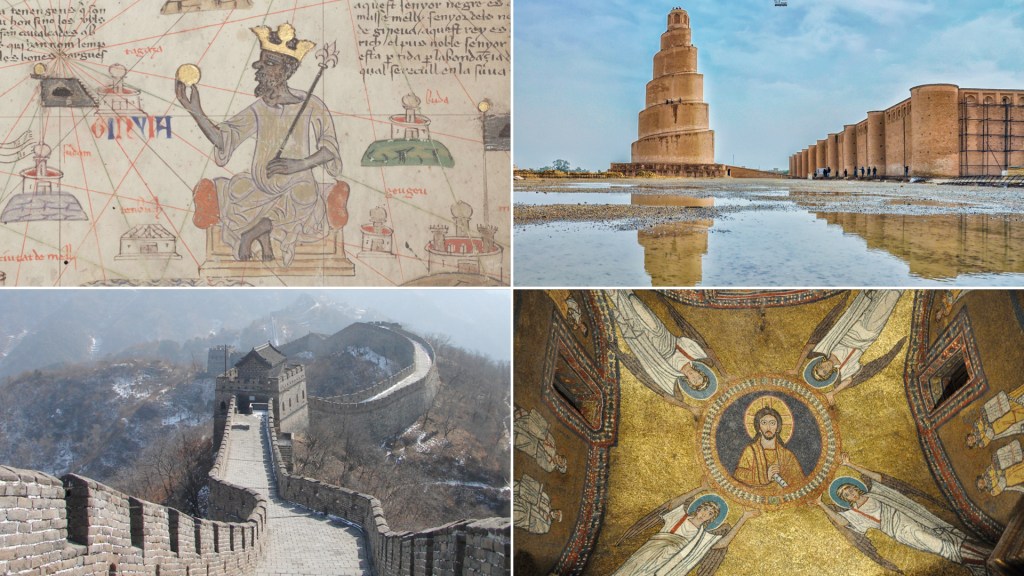
This Age is characterized by:
- The consolidation and transformation of post-classical states across Afro-Eurasia and the Americas, including but not limited to the Chola, Mongol, Khmer, Mali, Inca, and Ottoman Empires, Majapahit, the Norman and Viking states, the Swahili city-states, the maritime republics of Italy, and the Mississippian societies, most of which were multicultural and multilingual, characterized by tolerance of differing traditions (often following brutal conquest)
- The expansion, fusion, and increasing syncretization of major religious and philosophical traditions — particularly the missionary religions Christianity, Islam, and Buddhism, all of whom envisaged humanity as part of a universal order — whose practices shaped governance, education, law, and identities
- The dramatic rise in trade, opening the way for the spread of ideas, goods, and disease as trans-Saharan and Silk Road travel intensified and as routes were forged from Mesoamerica to North America, allowing more permanent settlements to blossom
- The increasingly systemic oppression of lower class peoples as the slave trade flourished in Africa and feudal systems were established in Europe and Japan, entrenching inequality and centralizing surplus extraction
- The rapid development of transformative technologies such as the heavy plow, gunpowder, the compass, paper, and printing, each, theoretically, reducing time spent laboring
Significance of start/end dates: This Age’s boundaries are primarily determined by the Ages that precede and follow it. See the Axial and Dominion Ages.
The Dominion Age
1500 CE – 1950 CE
11500 HE – 11950 HE
Length: 450 years
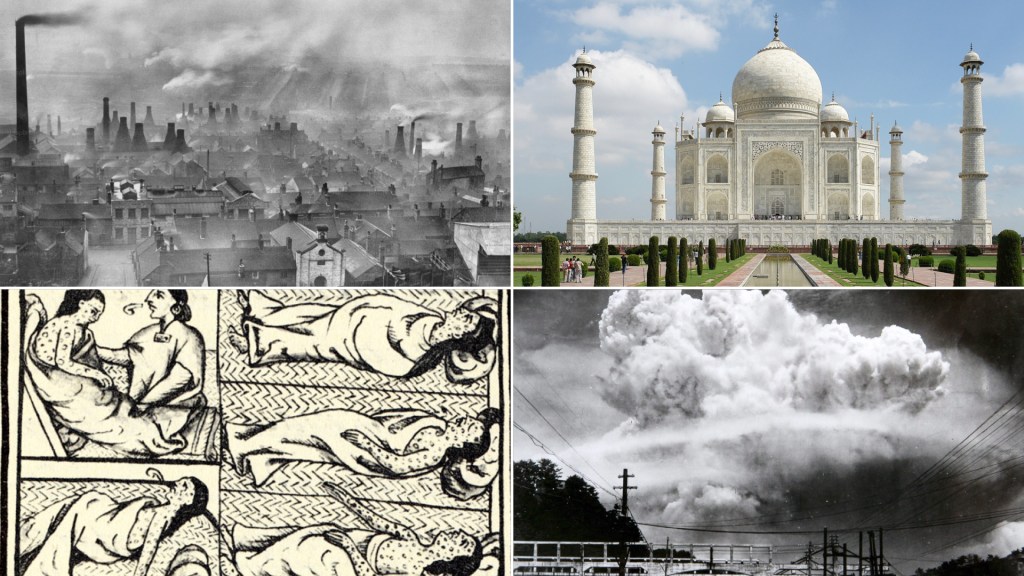
This Age is characterized by:
- The industrialization of Europe, the Americas, and Japan, which transformed production, urban life, energy use, travel (on land, sea, and significantly, air), and social organization, fostering vast population growth, encouraging rapid urbanization, and resulting in mass labor systems, greater wealth inequality, more inhumane warfare tactics, and unprecedented environmental harm
- The mass physical and cultural death of indigenous Americans from war, slavery, disease, and displacement and the disruption of diverse global ecosystems through the use of fossil fuels, urbanization, and worldwide exchanges which facilitated the spread of invasive species, beginning the Homogenocene
- The domination of extraction-based economics focused around plantation agriculture, transatlantic slavery, resource exploitation, mercantilist networks, and following industrialization, capitalism
- The proliferation of nation-states, revolutions, and global political movements such as liberalism, nationalism, socialism, and fascism that shaped the concepts of sovereignty; some worked to bring disparate groups together and promote equality while others extolled tribalism
- The gradual emergence of universal ideals and concepts such as natural rights, suffrage, abolitionism, environmentalism, and the rise of labor movements, challenging systems like divine kingship, hereditary monarchy, absolute authority, and growing exploitative economic practices
- The development of revolutionary mediums of art including photography, sound recording, and film, facilitating new ways of conveying human experience, feeling, and ideas to others
Significance of start date: This Age begins shortly after the beginning of European settlement in the Americas and the genocide and cultural erasure of its inhabitants. The world’s “balance of power” shifts from Asia to Europe.
The Modern Age
1950 CE – present
11950 HE – present
Length: ongoing

Each Age of Humanity will be referred to as “the Modern Age” until sufficient time has passed to determine its place and context within wider history. The current Modern Age is a pivotal period for humanity in which it must either make the choice to affirm Dominion-period values and risk personal and environmental annihilation or forge a path guided by unity, equality, justice, peace, and freedom from want and fear.
This Age is characterized by:
- The rapid expansion of technological and information networks, including digital computation, satellite communication, and the internet, all of which strengthened human connectivity and trivialized national barriers, while simultaneously amplifying systemic risk, polarization, and the spread of misinformation globally
- The emergence of global self-awareness, as humanity first perceives Earth as a single, fragile interconnected system of relations through ecology and the understanding of human-caused climate change as well as space exploration’s re-contextualization of humanity’s place in the cosmos
- The formation of international organizations and economic unions designed to promote cooperation between countries and extend the shadow of the future in light of the disastrous consequences wrought by colonialism and the World Wars
Significance of start date: This Age begins shortly after the conclusion of World War II and the establishment of the United Nations, both key events in humanity’s journey, either towards or away from realization of interconnectedness. It also marks the beginning of European de-colonization in Africa and Asia.
 Jiaya
Jiaya 
Leave a comment