“We abuse land because we regard it as a commodity belonging to us. When we see land as a community to which we belong, we may begin to use it with love and respect.”
– Aldo Leopold
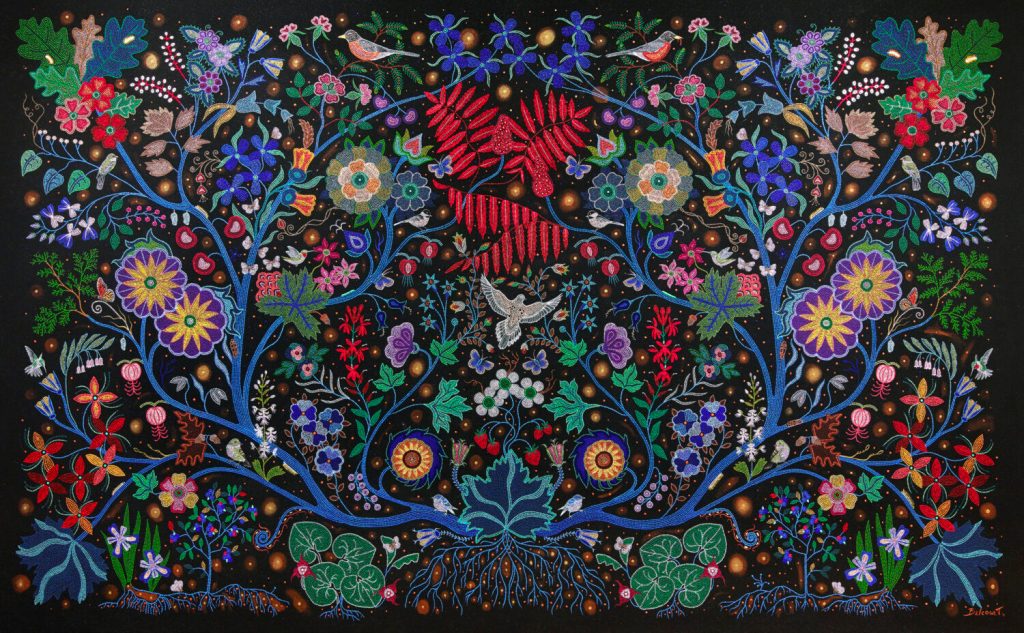
It’s a Delicate Balance by Christi Belcourt, 2021
To live in harmony with Ji is to recognize one’s place and humanity’s place in the interconnected web of existence. To embody this philosophy, we must adopt ecologically-based land ethics, particularly in the phase of impending worldwide climate disaster.
Ecologically-based land ethics is derived from systems thinking, a mode of thought that makes sense of the world’s complexity by looking at things in terms of the whole and relationships, rather than splitting them into parts. Jiaya operates by this framework as well, affirming it as the most sensible way to view our universe. The boundaries between things, objects, and bodies is illusory. Zoom in close enough and you would be unable to distinguish the molecules of your hand from what you’re touching. Only through attempting to understand, as best we can, the relationships that make up existence can we act accordingly.
Humans would not have been able to become a so-called apex predator without the benefits provided to us by other organisms and inanimate things, from the bacteria that plays a critical role in our digestion and nutrient absorption to the rocks that prehistoric peoples carved for hunting. Like individuals, humans are not a self-made species. And unlike other species, at least as far as we know, humans are the only animals capable of grasping the impact that they have on the environment in a physical and moral sense. This capability, combined with a recognition of nature’s intrinsic worth — for we are part of nature, not apart from it, and so to deny nature’s worth is to deny our own — is how we arrive at a land ethic that affirms existence within nature rather than a conception that places humans outside of or above it.
Land ethics do not require us to shun advanced society. We wouldn’t ask beavers to stop making dams because they’re manipulating the environment. Rather, it serves as a post for each interaction we have with our biosphere: is it necessary? Does it disrupt the stability and integrity of the ecosystem? Does it only consider the needs of humans without regard for anything else, living or inert?
Two examples illustrate the point here, one that coheres with and contributes to relational coherence and one that does not. Contrary to the well-meaning but paternalistic “noble savage” myth, indigenous peoples in the Americas did not passively let nature take its course. They actively shaped the landscape in ways that were not immediately obvious to European settlers, who viewed the North American landscape as an untouched wilderness on account of the lack of wanton destruction to make room for human settlement. Native Americans practiced cultural burning over many millennia, resulting in “the conversion of forest to grassland, savanna, scrub, open woodland, and forest with grassy openings.” (William M. Denevan)
They didn’t do this just to make the world more pretty either. Using fire to manage the environment had benefits including but not limited to increasing nut production, facilitating hunting by clearing underbrush and fallen limbs, promoting travel and trade through the creation of passages through forests, assisting in pollination, increasing biodiversity including the populations of game animals and medicinal plants, destroying tick and biting insect populations, and stimulating seed production and recycling nutrients in the soil. This knowledge of the environment was accumulated over generations and led to flourishing within the natural world. This diverse picturesque landscape encountered by white settlers appeared undisturbed as its inhabitants (former inhabitants in some areas, as the spread of disease had wiped out Natives by the time whites had even reached them) recognized nature’s health and wealth as their own. They sought to live in harmony with it, not conquer it.
Contrast this with the urban sprawl of the modern United States, where the natural environment has been cleared to make room for tall buildings, parking lots, and suburbs. Human-made material like pavement reflect less solar energy than natural surfaces that evolved to do exactly that. Roofs, sidewalks, and roads provide less shade and moisture than one would receive from trees, vegetation, and water bodies. Cities with narrow streets and tall buildings block natural wind flow. Vehicles, air-conditioning units, and industrial facilities emit heat into the urban environment.
All of these factors contribute to what is referred to as a “heat island”, where daytime temperatures are about 1–7°F higher than temperatures in outlying areas and nighttime temperatures about 2–5°F higher. This effect will only get worse as cities continue to grow. Not only is human quality of life generally impaired in such conditions, but emissions of greenhouse gases and pollutants see a marked increase as individuals and companies face a greater electrical demand to combat the high temperatures. Cultural burning sees the complete opposite effect: Aboriginal and Torres Strait Islander peoples reduce more than 1 million tons of greenhouse gases a year through such practices.
Thus, it can be stated that the genocide, both physical and cultural, of indigenous peoples has contributed to the climate crisis we find ourselves in today. Colonists and imperialists foolishly disregarded the environmental wisdom and only now, as the consequences of suppressing relationally coherent practices becomes apparent, is backtracking occurring. We should take this as a lesson for the future.
 Jiaya
Jiaya 
Leave a comment