“Since happiness is an activity of soul in accordance with perfect virtue, we must consider the nature of virtue; for perhaps we shall thus see better the nature of happiness.”
– Aristotle
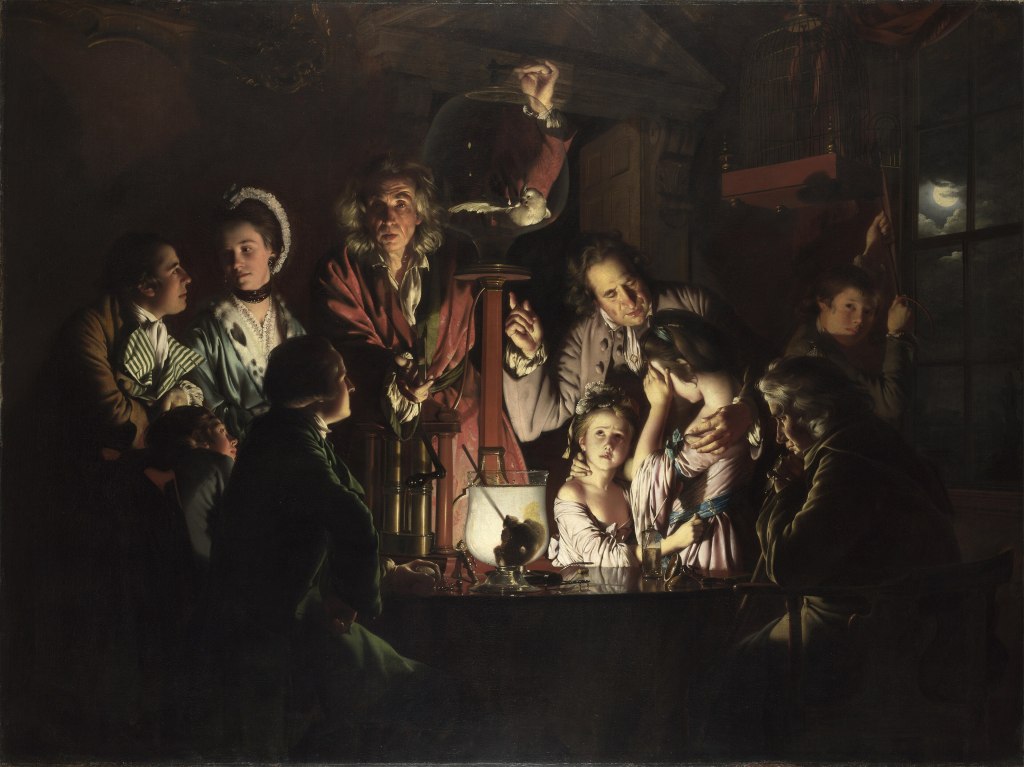
An Experiment on a Bird in the Air Pump by Joseph Wright, 1768
Over the course of human history, our understanding of the physical world has become more attuned with Reality through reasoning, superior technologies, and research. We cannot claim to know absolute truth — the millennia-long scientific process unwittingly embarked upon by our ancestors and later purposefully pursued by scholars, can only represent humanity’s current, best guess as to how the universe functions. In no way does any scientific finding claim to be the final word on the matter.
In this way, it mirrors the Jiayan conception of epektasis, which I borrowed from St. Gregory. Gregory described epektasis as the soul’s eternal journey of growth into God’s infinite being. Jiayan epektasis operates simultaneously on societal-civilizational and individual axes, with both informing the other. With independent growth (growth in this sense meaning striving for alignment with Ji, or seeking to cultivate good, skillful behaviors) comes societal growth (civilizational flourishing resulting in collective well-being), and societal growth can also foster the conditions for individual growth. Epektasis is infinite for neither people nor the collective can ever reach the perfect, much how the human mind’s capacity to understand the universe limits a completely accurate scientific formulation of all things.
In the Jiayan worldview, the conclusions drawn in both science and morality are not so different in how they are devised and reached. Take evolutionary theory for instance. While certain aspects of our finite understanding of biology may be incorrect or inaccurate at present, we know that the theses and assumptions underpinning evolutionary science must be true because of how our understanding is applied. If the facts behind evolutionary biology were false, we would expect radically different results in the fields of medicine, agriculture, computer science, and genetic engineering. If evolution were not a fact of nature, then scientists would not currently be finding ways to combat antimicrobial resistance, which occurs when microbes evolve to protect themselves from antibiotics.
Jiayan morals and ethics function in a similar mode. As we are able to confirm the validity of scientific hypotheses through testing, so we can confirm whether an action is aligned with Ji through its effect on well-being and flourishing, both individual and collective. We do not determine whether an act is just by its effect on well-being; rather, well-being is the most legible expression of our relational reality. Actions aligned with Ji, grounded in the recognition of our fundamental interdependence, tend toward flourishing; those that violate it tend towards fragmentation. As the resistance of human diseases to pharmaceuticals reveals the truth of evolution, so too do the outcomes of skillful actions reveal Ji’s nature.
Both individual and collective well-being must be considered in a fluid, contextually dynamic balance; one oriented by mettā-karuṇā, the cultivation of loving-kindness and compassionate action toward all beings. It can be said that the well-being of the individual is prioritized “too much” when the fabric of society begins to unravel — distrust in others and our communities form, faith in people and institutions is lost, people gravitate to radicalism and strongmen, and “personal responsibility” is upheld over duty to our fellow human.
A collective can be prioritized “too much” when identity, creativity, and feeling are stifled in service of efficiency and obligation. Nature, in its paradigmatic splendor, reminds us of the beauty of expression and individuality when directed towards purpose rather than ego. When a collective or group mentality seems to sap the world of color, it is incumbent on the individual to be an artist.
Human morality has evolved over time, with the various cultures and peoples of the world possessing varying opinions on issues to this day. To cite a well-worn example, as I write this, there are many people who believe that a person loving another person of the same sex is a moral abomination due to deeply ingrained prejudices and erroneous notions. This is emblematic of what societal epektasis means. The moral journey of humanity is never concluded. There will always be another ethical battle to be fought.
When we ponder the skillful nature of an action, our primary consideration must be the impact it has on well-being, not because it is an end in and of itself but because it serves as a sign that we are acting in accordance with Ji and the interdependence that grounds all things.
 Jiaya
Jiaya 
Leave a comment