“The movement of the Tao consists in Returning. The use of the Tao consists in Softness. All things under heaven are born of the manifested. The manifested is born of the unmanifested.”
– Laozi
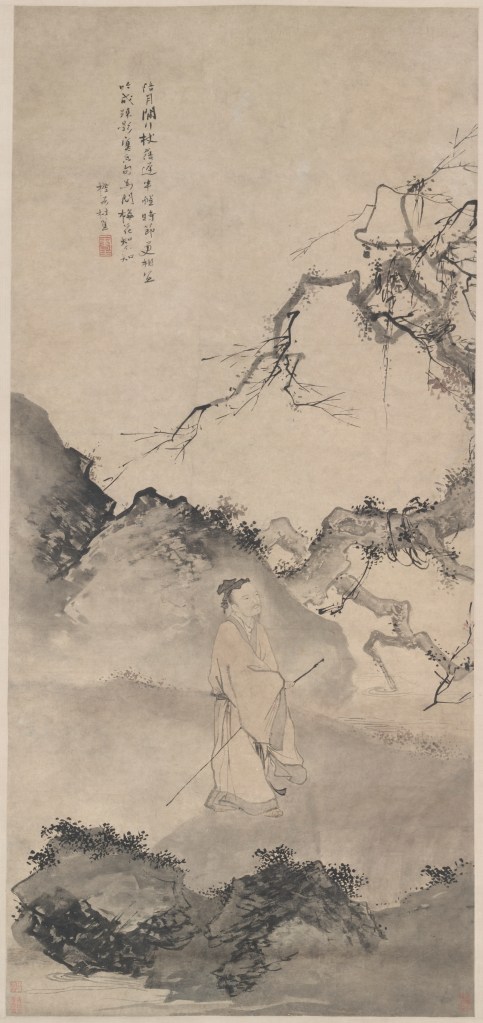
The Poet Lin Bu Wandering in the Moonlight by Du Jin, late 1400s
Sometimes it’s best to use labels yourself before others can have an opportunity to apply them to you. It is for this reason that I’ve created the term “pulse ontology” to describe the Jiayan view of the world and its relations, and the way by which Ji operates at every scale of reality.
I find the word “pulse” particularly apt here because it evokes both the beating of a heart and the rhythms of most anything, but especially the ocean, which is a metaphor I’ve used for Ji before.
Nothing ever repeats in exactly the same way, but they do rhyme and past events or occasions inform present and future ones, which is what the pulse framing serves to illustrate. When we see a wave rising above the water’s surface, we can make reasonable conclusions as to how it will affect the water’s behavior and character as it crashes down. Stressors push a heart to its limit, while activity and peace keep a heart healthy. The pulse ensures that while every heartbeat is unique, however subtle the differences, they all follow the meter of the heart’s history.
At the immanent level, within our current universe, Ji‘s pulse is experienced as discrete occasions of experience arising, prehending what came before, contributing their effects to the relational web and thus enhancing its integrative continuity, and then dissolving back into it. Every action, whether undertaken by a conscious or unconscious entity, whether they contribute to flourishing or fragmentation, contributes to the experiential depth of Ji which is carried forward into future occasions.
In contrast to hypotheses centered around homeostasis, Jiaya does not recognize a kind of equilibrium within the universe that needs to be maintained. It is true that disharmony tends to be reconciled but that is not the same as a universal self-regulating system. For example, human-caused climate change could result in planetary catastrophe which could wipe out human civilization as we know it. This is what is meant in Jiaya by reconciliation of disharmony — things aren’t “fixed” by nature just the way they were. Rather, the weight of fragmentation eventually collapses the structures that created it.
To extend the ocean metaphor to the sound of the breath, as the rise and fall of tides are so often compared, an inhale could represent fragmentary occasions absorbed by the relational web. An exhale is then the aftermath of fragmentation; the inheritance of the fragmentary occasions that could someday lead to flourishing. There are no guarantees.
Pulse ontology can also be applied beyond our conception of time, to a grander cosmological scale. Ji may oscillate between unmanifested potentiality (in the ocean metaphor, complete calm) and manifested actuality, our or any universe. As each universe dissolves, its relational pattern is not annihilated but preserved as a structural imprint within Ji, shaping whatever manifestation follows. The universe’s causal signature persists within Ji, much like each occasion of experience persists within another.
Another Use of Pulse Ontology
In my quest to determine whether or not I originated the term “pulse ontology”, I found that an independent researcher by the name of Mohamed Khorwat had published a paper on the topic in September 2025, about five months before I wrote the ocean metaphor. Hm…why don’t we call it a draw?
All kidding aside, our conceptions, or at least our applications of the idea differ. In Khorwat’s framework, the pulses in question are “discrete disclosures of potential into actuality, grounded in field excitations, entanglement entropy, and holographic projection.” He seeks to reconcile eternalism, the view in which all time (past, present, and future; an unchanging four-dimensional “block” view of the universe) is equally “real”, with becoming and novelty.
Khorwat explicitly cites Whitehead’s process philosophy as too empirically loose, stating that it “[lacks] integration with physical theory” and treats “time as metaphysical creation ex nihilo.” Clearly, Khorwat is more mathematically formal than I would be on the scientific and physics front, given that I wouldn’t dare to step my toes into waters I’m incredibly ignorant on. That is not my realm of expertise and it’s something I would leave to those who know more than me, hence the existence of the three tiers of claims.
In Jiayan thought, pulse ontology is a philosophical description of the universe first and foremost. I’m not so much concerned with finding a literal “quantum pulse” as I am creating poetic language to describe the way our world functions so that we may work to live in alignment with its rhythms.
 Jiaya
Jiaya 
Leave a comment